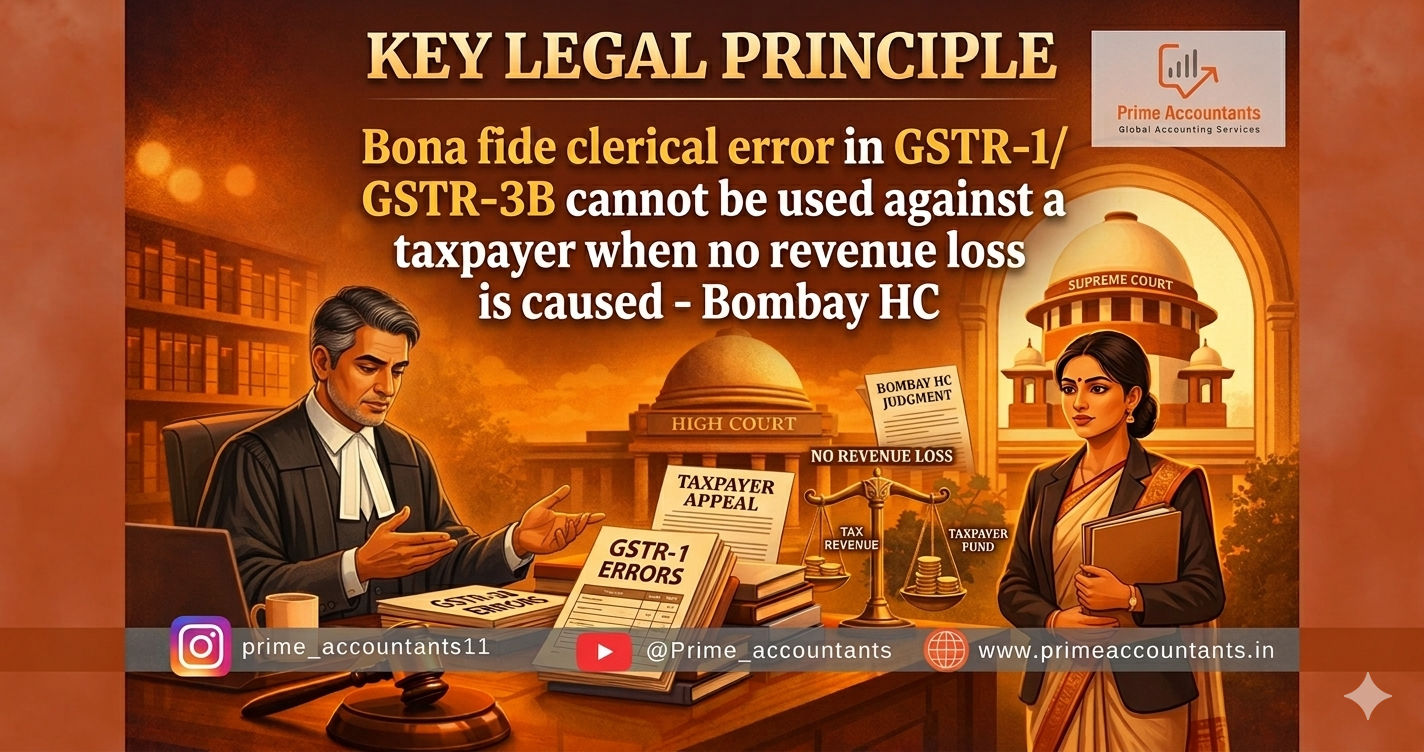
Bombay HC in case of Aberdare Technologies Pvt. Ltd. v. CBIC - Explained

The Bombay High Court has delivered a landmark ruling that every GST-registered business should know about. In Aberdare Technologies Pvt. Ltd. v. CBIC, the Court held that a bona fide clerical error in GSTR-1 or GSTR-3B cannot be used against a taxpayer when no revenue loss is caused to the Government. Cutting through procedural rigidity, the Court directed authorities to either open the portal for rectification or accept manual corrections. On contested ahead, the Hon’ble Supreme Court affirmed.
1. Background & Facts
The Petitioner, Aberdare Technologies Pvt. Ltd., filed its GST returns (GSTR-1 and GSTR-3B) within the prescribed time for the relevant financial year. Subsequently, in December 2023, the Petitioner discovered that there were certain clerical errors in the returns as filed. Crucially, these errors did not result in any loss of Revenue to the Government.
Upon discovering the errors, the Petitioner made a written request to the concerned tax authorities seeking permission to rectify/amend the erroneous particulars in the GSTR-1 and GSTR-3B returns. This request was not granted by the authorities, who relied upon the statutory cutoff under Section 39(9) of the Central Goods and Services Tax Act, 2017 (CGST Act), which bars rectification after the 30th day of November following the end of the relevant financial year (or the date of furnishing the annual return, whichever is earlier).
The Petitioner therefore approached the Bombay High Court by way of Writ Petition No. 7912 of 2024.
2. Statutory Framework
2.1 Section 37 of the CGST Act
Section 37 deals with the furnishing of details of outward supplies. Sub-section (3) provides for the amendment of details of outward supplies already furnished. The proviso to sub-section (3) imposes a time limit, restricting the ability to amend such details after 30th November following the end of the relevant financial year.
2.2 Section 38 of the CGST Act
Section 38 deals with the auto-generated statement of inward supplies (GSTR-2A/2B). Sub-section (2) provides for the ingredients of this auto-generated statement, which is directly dependent upon details furnished under Section 37 by the supplier.
2.3 Section 39(9) and 39(10) of the CGST Act
Section 39 governs the furnishing of returns in the prescribed form (GSTR-3B). Sub-section (9) permits rectification of any omission or incorrect particulars, but contains a proviso that precludes rectification after:
• The 30th day of November following the end of the financial year to which such details pertain; or
• The actual date of furnishing of the relevant annual return — whichever is earlier.
The tax authorities relied upon this proviso to reject the Petitioner's request for rectification.
3. Legal Issue Framed
The core legal question before the Court was:
Whether a taxpayer can be absolutely and permanently barred from correcting a bona fide, inadvertent clerical error in GST returns (GSTR-1 and GSTR-3B) solely on account of the expiry of the statutory deadline under the proviso to Section 37(3) read with Section 39(9) of the CGST Act, when there is no loss of Revenue whatsoever to the Government?
4. Precedent Relied Upon
The Additional Government Pleader, Ms. S.D. Vyas, herself fairly brought to the Court's attention a relevant earlier judgment of the same Court:
1. Star Engineers (I) Pvt. Ltd. v. Union of India & Ors. — Writ Petition No. 15368 of 2023, decided on 14th December 2023 (2023 SCC OnLine Bom 2682).
In Star Engineers, the Bombay High Court had categorically held that if there is no loss of Revenue to the Government, amendment/ rectification of GSTR-1 should be permitted even if the request is made after 30th November.
The Court in the present case found the facts of Aberdare Technologies to be virtually identical to those in Star Engineers, and therefore followed and applied the ratio of that judgment.
5. Court's Analysis & Reasoning
The Division Bench, comprising K.R. Shriram J. and Jitendra Jain J., undertook a detailed statutory analysis of Sections 37, 38 and 39 of the CGST Act and arrived at the following key conclusions:
5.1 Purposive Interpretation of Sections 37(3), 38 and 39(9)
The Court held that the provisions of sub-section (3) of Section 37, read with Section 38 and sub-sections (9) and (10) of Section 39, need to be interpreted purposively. The Court expressly declined to read sub-section (3) of Section 37 as preventing the assessee from placing the correct and accurate particulars in GST returns.
5.2 No Scope to Deny Bona Fide Rectification
A reading of the provisions that creates an absolute bar against bona fide and inadvertent rectification was rejected. The Court held that such an interpretation would pre-suppose that any inadvertent error, once permitted to be rectified, could be defeated merely by a technicality and that this outcome is impermissible.
5.3 Technicality Cannot Override Substantive Rights
The Court laid down the principle that a technicality that does not create a window for rectification of bona fide, inadvertent errors ought not to defeat the provisions of sub-section (3) of Section 37 read with sub-section (9) of Section 39. In other words, procedural/technical constraints must yield to the substantive right of the taxpayer to have accurate particulars on record when no harm accrues to the Revenue.
6. Directions Issued by the Court
The Court issued the following specific directions, disposing of the writ petition:
2. Portal to be Opened: The Respondents were directed to open the GST portal within one week from the date of the order being uploaded, to enable the Petitioner to amend/rectify Form GSTR-1 and GSTR-3B.
3. Manual Rectification as Alternative: If the portal cannot be opened for whatever reason, the Petitioner shall file an application to amend/rectify Form GSTR-1 and GSTR-3B manually. Respondent Nos. 2 and 3 were directed to accept and process the same in accordance with law.
4. Advance Notice & Hearing: If Respondent Nos. 2 and 3 intend to take a stand contrary to the Petitioner's interest, they shall give notice to the Petitioner of at least five working days in advance and afford a personal hearing before doing so.
5. Petition Disposed: The Writ Petition was disposed of in the above terms.
7. Supreme Court Outcome (2025)
CBIC challenged the Bombay High Court judgment before the Supreme Court of India by filing a Special Leave Petition, vide SLP Number - SLP (Civil) No. 7903 of 2025. Supreme Court vide its order dated 21st March 2025, dismissed the SLP and upheld the Bombay HC ruling.
The Supreme Court, in dismissing the SLP, reinforced the principle that taxpayers have a right to rectify genuine clerical and arithmetical errors in GST filings. The Apex Court additionally directed the CBIC to re-examine the timelines prescribed under Sections 37(3) and 39(9) of the CGST Act for rectification of such errors.
8. Significance & Takeaways
This judgment carries the following key takeaways for taxpayers, practitioners and the Revenue:
• Clerical errors in GSTR-1 and GSTR-3B can be corrected even beyond the statutory deadline, provided there is no loss of Revenue.
• Authorities must either facilitate portal-based rectification or accept manual applications — they cannot simply refuse without engaging with the merits.
• If authorities wish to oppose rectification, they must provide advance notice and a personal hearing.
• The judgment protects buyers from loss of Input Tax Credit (ITC) arising from suppliers' filing errors, where tax has already been paid to the Government.
• Courts will not allow procedural technicalities to defeat substantive taxpayer rights where no Revenue harm is demonstrated.
• The Supreme Court's dismissal of the SLP makes this a binding precedent applicable across India.
• CBIC has been directed to revisit its policies on rectification timelines — signaling potential systemic reform.
Disclaimer: This article is intended for qualified tax professionals and general knowledge dissemination and does not constitute legal advice for specific matters. GST law is subject to frequent amendments and works in tandem with evolving judicial interpretations. Independent professional advice should be separately obtained for any specific client matter. Prime Accountants accepts no liability for decisions taken in reliance on this article without independent verification.

Comments