ISD vs Cross Charge under GST: Karnataka HC Settles the Debate in Micro Labs Case

Introduction
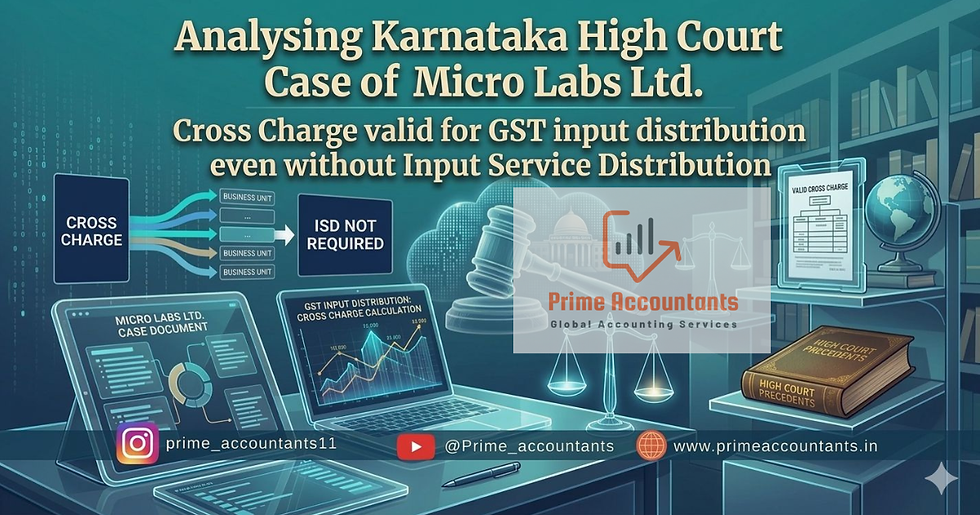
In a significant ruling, Hon’ble High Court of Karnataka, in the case of M/s. Micro Labs Limited vs. Joint Commissioner of Central GST (Writ Petition No. 8409 of 2025), addressed the long-standing controversy regarding the distribution of Input Tax Credit (ITC). The judgment, delivered on December 9, 2025, provides much-needed clarity on whether a Head Office (HO) is mandatorily required to use the Input Service Distributor (ISD) mechanism or if it can opt for the "cross-charge" method via issuance of tax invoices for distributing common input services to its Branch Offices (BOs).
Factual Background
Micro Labs Limited (petitioner) is a major pharmaceutical manufacturer headquartered in Bengaluru, operating across 20 states in India. To manage its vast operations, the Bengaluru HO procures various common services under both Input Service Ditributor model and also under its regular GST registration. Such common inout services such as legal consultancy, GTA services and OIDAR services are utilized by its multiple units nationwide.
For this, the petitioner maintained two distinct registration types:
1) Input Service Distributor (ISD): Used to distribute ITC on services received under the Forward Charge Mechanism (FCM).
2) Regular GST Registration: Used to distribute ITC for services liable under the Reverse Charge Mechanism (RCM) through "cross-charging" by issuing tax invoices under Section 31 of the CGST Act.
The Directorate General of GST Intelligence (DGGI) initiated an investigation, alleging that the distribution of common credit must be done exclusively through the ISD mechanism. Consequently, an Order-in-Original (OIO) was passed on January 24, 2025, dema
nding a reversal of ITC, along with interest and heavy penalties.
Key Legal Issues and Findings
The core of the dispute rested on whether the ISD mechanism was mandatory for the period between July 2017 and March 2022.
1. The Optional Nature of ISD (Pre-Amendment)
The Court observed that under the original Section 2(61) of the CGST Act, the definition of an ISD was restricted to an office receiving tax invoices under Section 31. The petitioner argued and the Court agreed, that this definition effectively barred the distribution of RCM-related ITC through the ISD route during the relevant period.
2. Reliance on CBIC Circular No. 199/11/2023-GST
A pivotal element of the judgment was the Court’s reliance on Circular No. 199/11/2023-GST, issued by the Ministry of Finance on July 17, 2023. This circular explicitly clarified that:
HOs had an option to distribute ITC for common input services either through the ISD mechanism or by issuing tax invoices (cross-charge).
The use of the ISD mechanism was not mandatory under the then-existing provisions of the CGST Act and Rules.
The High Court held that the tax authorities' order was "illegal, arbitrary and without jurisdiction" because it completely disregarded this binding circular.
3. The Impact of the Finance Act, 2024
The Court noted that the law was only made mandatory through an amendment in the Finance Act, 2024, effective from April 1, 2025. By amending Section 2(61), the legislature finally included RCM invoices within the ISD framework and made the mechanism compulsory moving forward. This reinforced the petitioner’s stance that for the retrospective period (2017-2022), no such mandate existed.
Stakeholder Impact Analysis
A. Impact on Taxpayers (Corporates)
Validation of Past Practices: This judgment provides immense relief to multi-state entities that followed the cross-charge mechanism before 2025. It protects them from being forced to reverse credits that were already legally utilized by branch offices.
Reduced Litigation: By quashing the demand for interest under Section 50 and penalties under Section 74, the Court has set a precedent that will likely cause the withdrawal of similar show-cause notices issued to other taxpayers.
B. Impact on Tax Authorities
Adherence to Circulars: The ruling serves as a stern reminder that field formations and adjudicating officers are legally bound by CBIC circulars. Assessments that contradict clarified policy positions are liable to be struck down as "without jurisdiction".
Procedural Shift: Authorities must now recognize the distinction between the pre-April 2025 era (optional ISD) and the post-April 2025 era (mandatory ISD) when conducting audits.
C. Impact on Legal and Tax Consultants
Strategic Planning: Professionals must now ensure that clients have transitioned to the mandatory ISD registration for all common service distributions from the 2025-26 financial year onwards.
Dispute Resolution: This judgment provides a robust defense for pending litigations where "revenue neutrality" (where tax was paid by one unit and claimed by another within the same PAN) is the core argument.
Conclusion
The Micro Labs judgment is a landmark victory for taxpayer certainty. By upholding the validity of the cross-charge mechanism for the period prior to April 1, 2025, the Karnataka High Court has prevented the "distortion of the credit chain" and protected businesses from unfair penalties. While the law has now evolved to make ISD mandatory, this ruling ensures that the transition to the new regime does not come at the cost of penalizing legitimate business practices of the past.
Disclaimer: This article is intended for qualified tax professionals and general knowledge dissemination and does not constitute legal advice for specific matters. GST law is subject to frequent amendments and works in tandem with evolving judicial interpretations. Independent professional advice should be separately obtained for any specific client matter. Prime Accountants accepts no liability for decisions taken in reliance on this article without independent verification.

Comments